In the precision world of metal machining, cutting tools and CNC machines usually take the spotlight. But cutting fluid—the quiet workhorse behind the scenes—subtly governs nearly every dimension of part quality. From micron-level size drift to nanometer-level surface finish, the right (or wrong) fluid can be the deciding variable.
Rolitom Lubricant Technology is a professional Chinese enterprise specializing in the R&D and production of MetalWorking Fluids. It focuses on the independent research, development, formulation optimization and mass production of high-performance metalworking fluids, covering a full range of products suitable for various metal machining scenarios. The enterprise hosts regular offline technical seminars on cutting fluids and release agents. You are welcome to visit the enterprise for hands-on exchange and technical cooperation.
Cooling Performance
Friction between tool and workpiece generates intense heat, causing thermal expansion during cutting and contraction after cooling—the classic recipe for dimensional drift. In precision turning of slender shafts, for instance, inadequate cooling leads to local overheating, bending, and severe loss of cylindricity and parallelism.
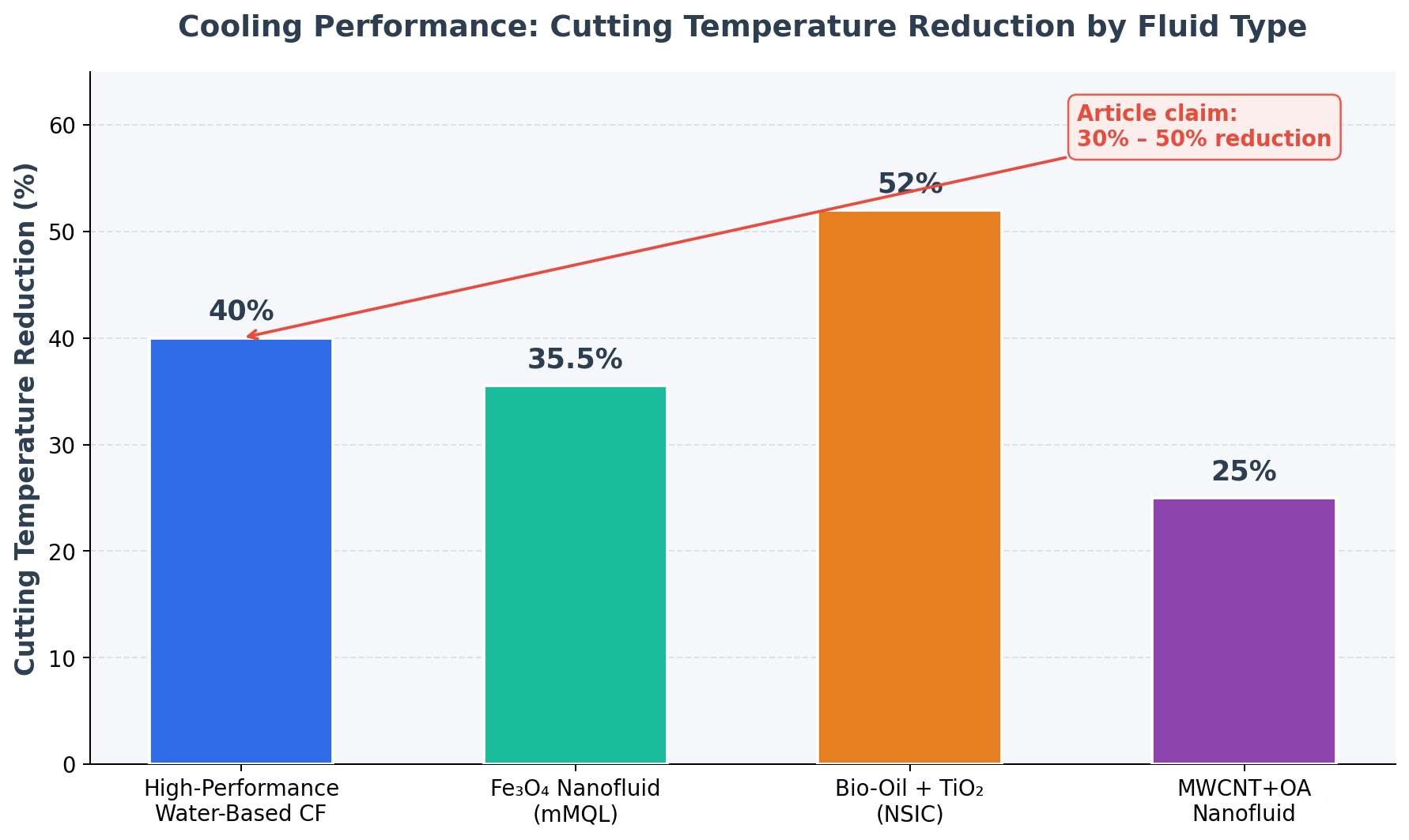
Quality cutting fluids remove that heat fast. Water-based fluids, with their high specific heat and latent heat of vaporization, can drop cutting temperatures by 30%–50% . That keeps thermal deformation minimal and dimensional accuracy stable.
Chart 1 below validates this claim against multiple peer-reviewed studies.
Lubrication Performance
Tool-workpiece friction does double damage: it accelerates tool wear and leaves scratches and plowing marks on the freshly cut surface. Lubricating additives in the fluid form a protective film that lowers the friction coefficient. Oil-based and nanofluid-enhanced fluids are especially effective on difficult alloys like high-strength steel and Inconel.
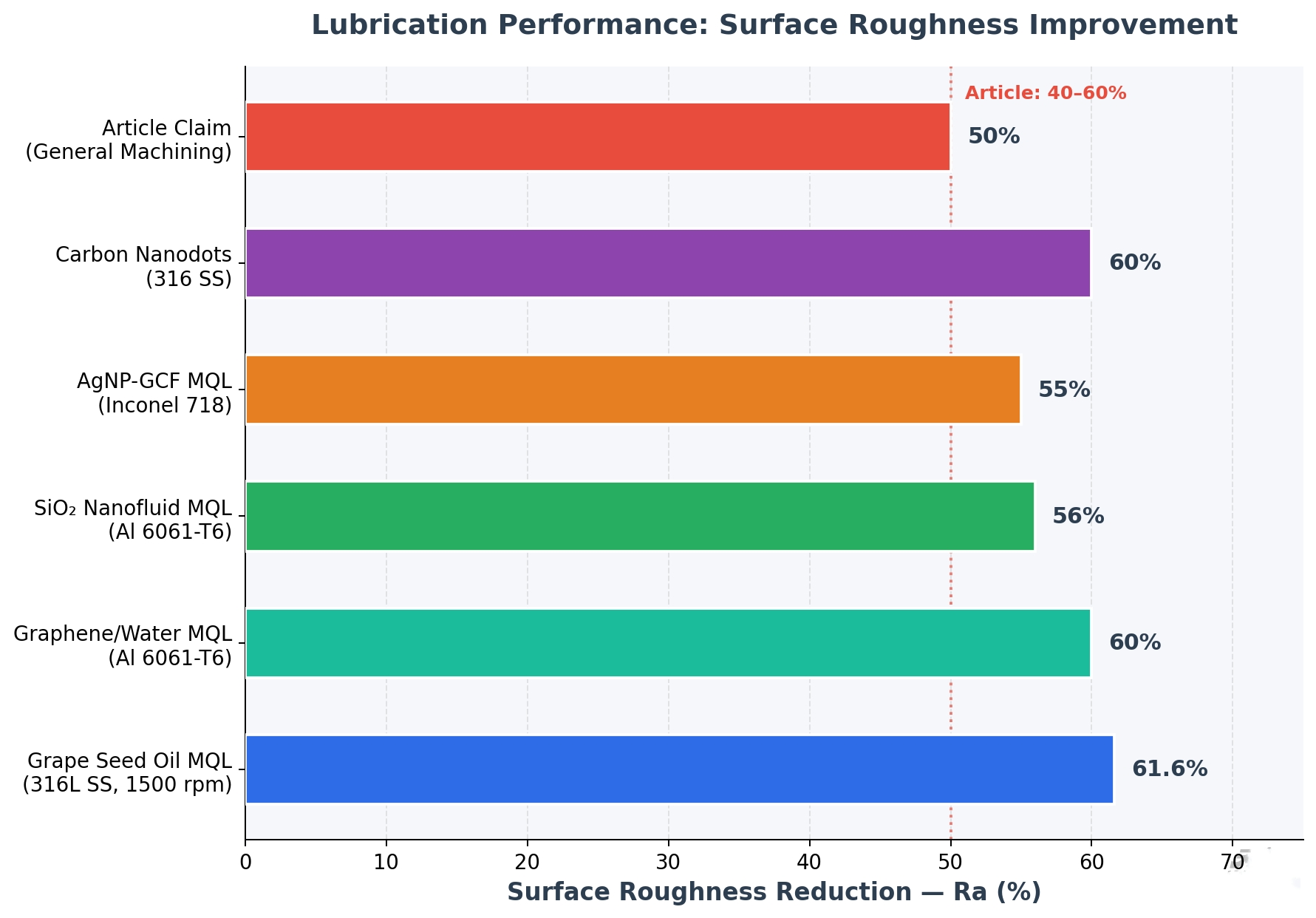
When lubrication is poor, cutting forces rise, vibration sets in, and chatter marks ruin the surface. Studies consistently show that well-chosen lubricating fluids reduce surface roughness (Ra) by 40%–60% .
Chart 2 benchmarks the article's claim against five independent research papers.
Cleaning Performance
Chips trapped between tool and workpiece scratch finished surfaces and can even cause tool chipping. The fluid's cleaning action—driven by flow and pressure—acts like a janitor, flushing chips away. Water-based fluids excel here thanks to high fluidity and wetting, especially in drilling, milling, and deep-hole operations.
Poor cleaning means chip buildup, uneven cutting forces, and vibration—all enemies of accuracy. In deep-hole drilling, high-pressure flushing fluids are essential to maintain hole straightness and cylindricity.
Rust Prevention Performance
After machining, bare metal exposed to humidity rusts quickly, degrading both surface quality and dimensions. Rust-preventive additives lay down a dense protective film that seals out air and moisture—critical for parts that must be stored or shipped.
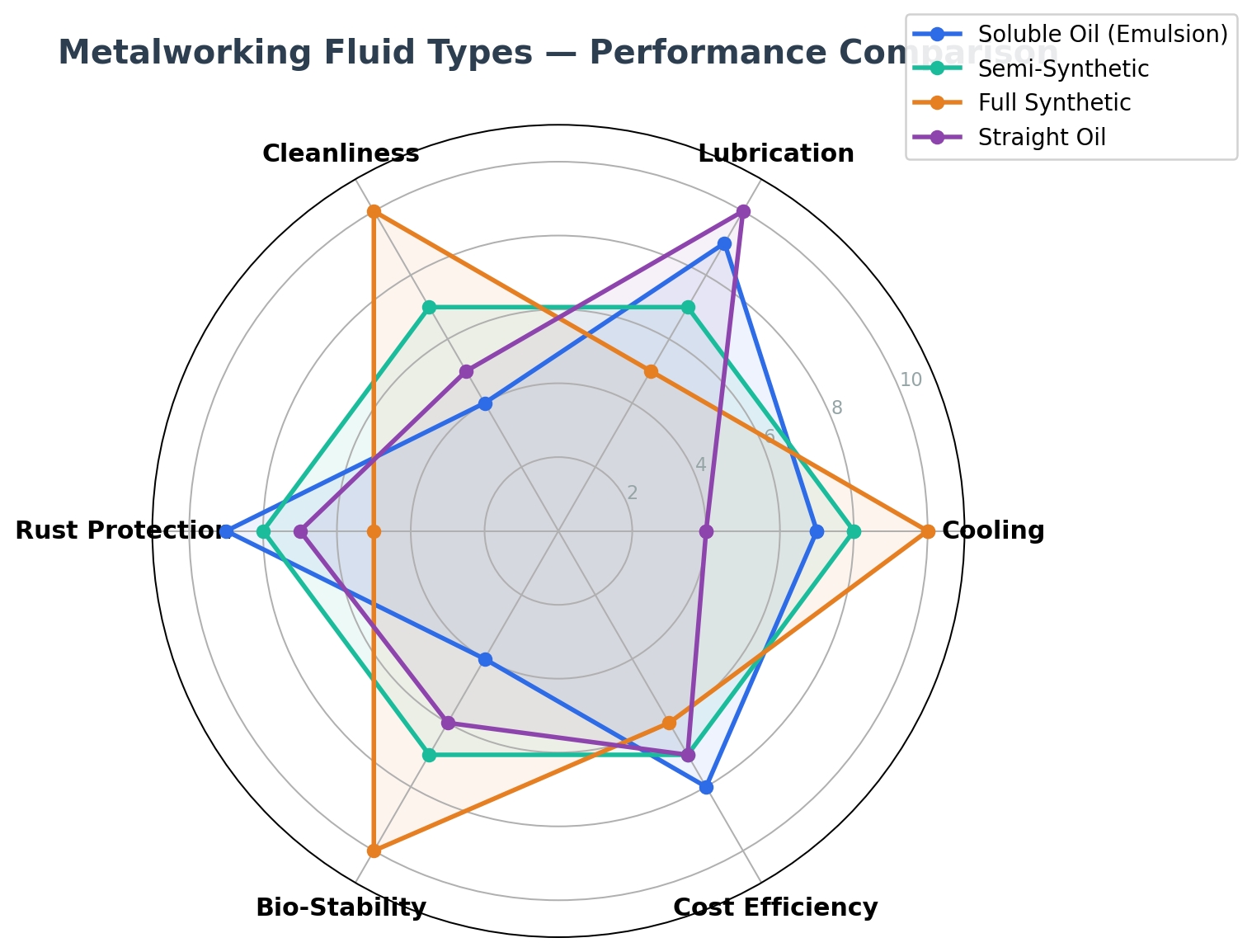
Different fluid families differ in this respect: emulsions and semi-synthetics typically contain rust inhibitors, while full synthetics rely on specialized additives. Long-term storage or ocean shipping calls for long-life rust-prevention grades.
Chart 3 maps the trade-offs across the four main fluid families.
Choosing the Right Fluid
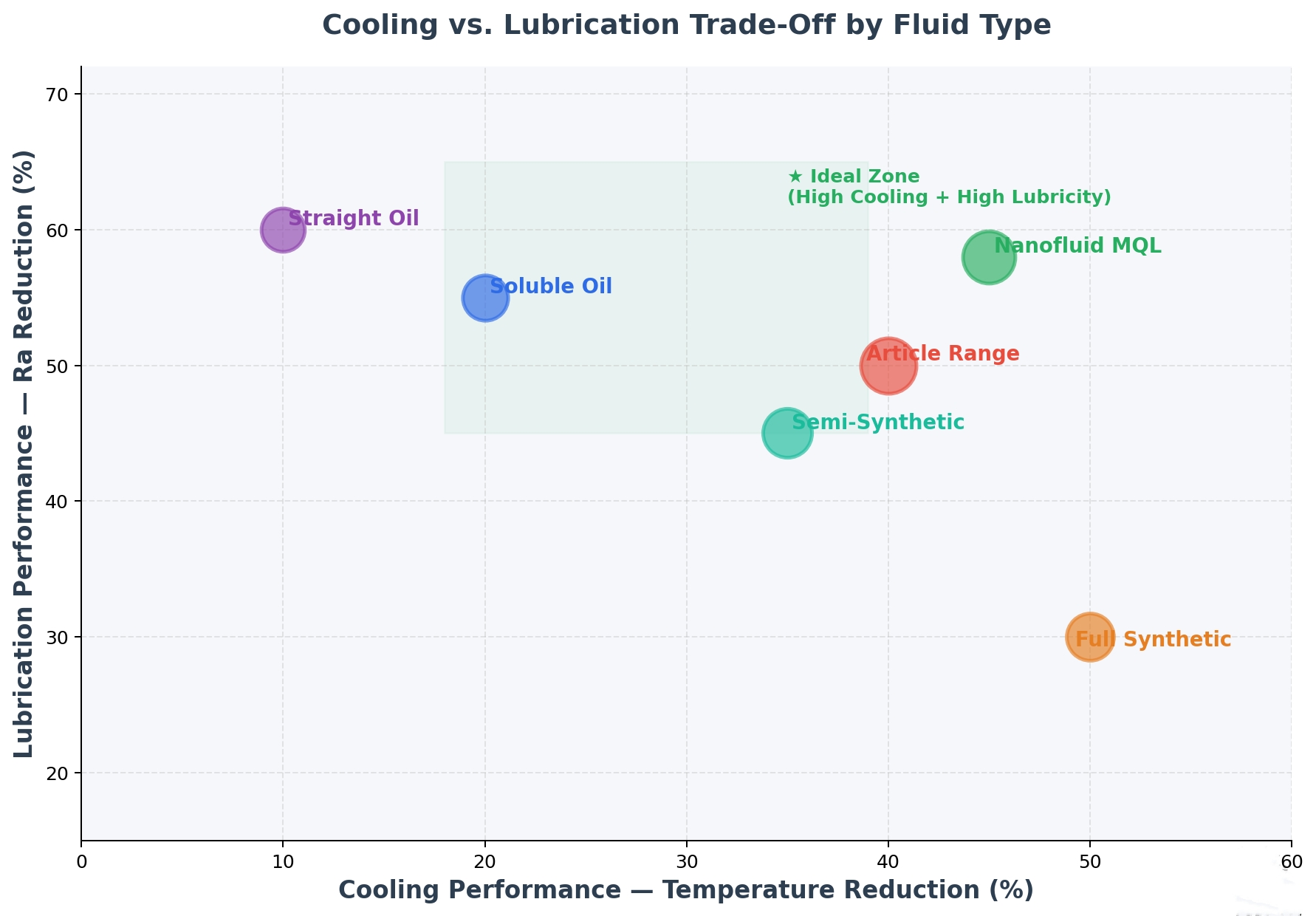
What looks like an ordinary liquid is in fact an invisible commander of machining precision. Cooling, lubrication, cleaning, and rust prevention are all tightly coupled to the final part. Select and apply the right cutting fluid, and every cut stays precise—delivering high-quality, precision-engineered components.
Contact: LilyLu
Phone: +86 138 2603 0637
E-mail: lilylu@rolitom.com
Whatsapp:+8613826030637
Add: Room 426, No.1218 Zhongshan Avenue Middle, Tianhe District, Guangzhou City,China
We chat